
DRUGSTORE BEETLE
Stegobium paniceum (Linnaeus)
[Coleoptera: Anobiidae]
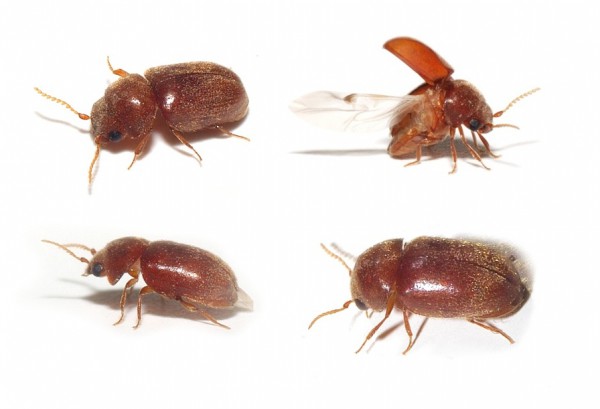
How To Get Rid of Drugstore Beetles
Drugstore beetles (Stegobium paniceum) are a classic stored-product pest. Effective and safe pest control requires a regular source-elimination strategy, not just a quick spraying.
1. Confirm the Identification
The drugstore beetle is often confused with the cigarette beetle (Lasioderma serricorne). Key traits of drugstore beetles:
~2-3 mm long
Reddish-brown
Grooved wing covers (elytra)
Found in pantries, medicine cabinets, pet food, spices and roof voids after rodent baiting treatments.
If you’re seeing small brown beetles around windows or light fittings, they’re likely emerging adults.
2. Locate the Infestation Source (Critical Step)
They breed inside dry stored products, including:
Flour, rice, pasta, cereals
Spices and herbs (very common source)
Pet food
Bird seed
Dried flowers / potpourri
Pharmaceutical tablets
Tea bags
Decorative seed crafts
Rodent baits (as they can eat the cereals and not get affected by the poison).
Drugstore beetles survive rodent bait because:
The toxic mechanism targets mammals, not insects
Exposure dose is minimal
Their detox systems neutralize low-level toxins
They are feeding on the grain carrier, not the poison
Open and inspect every susceptible product. Look for:
Fine powder (frass)
Webbing
Small exit holes in packaging
Live larvae or beetles
Discard any infested item in a sealed bag immediately.
3. Deep Clean the Area
After removing infested goods:
Vacuum shelves, cracks, corners, and shelf pin holes.
Dispose of the vacuum bag immediately.
Wipe surfaces with warm soapy water.
Optional: light surface spray of a residual insecticide labeled for pantry pests (do not spray food-contact surfaces directly).
Do not rely on surface sprays alone — they do not solve internal infestations.
4. Freeze Salvageable Goods
If you want to keep unopened or suspect items:
Freeze at –18°C for 3–7 days
This kills eggs and larvae
5. Prevent Re-Infestation
Store dry goods in airtight containers (glass, metal, thick plastic).
Avoid keeping bulk spices for long periods.
Rotate pantry stock.
Keep pet food sealed.
Inspect groceries before storage.
6. When Professional Treatment Is Needed
Call a licensed pest manager like A1 Pest Control if:
Infestation persists after source removal
Beetles are emerging from walls (may indicate old rodent nests or concealed food source)
You operate a commercial premises
Professionals may use:
Residual insecticide treatments
Insect growth regulators
Targeted dusting in voids
Pheromone monitoring traps
Important:
Adult beetles can continue emerging for 2-8 weeks after source removal due to lifecycle timing. This does not necessarily mean failure, it may just be residual emergence.
Drugstore Beetles Causing Havoc in your Kitchen and Roof Void areas?
Drugstore Beetle Pest Control Application Methods
- Cislin 25 (Liquid Spray):
- Usage: Applied as a residual surface spray. It is typically diluted with water according to product instructions and applied using appropriate spraying equipment.
- Target Areas: Professionals often target “sheltered areas” such as cracks, crevices, under equipment, floors, walls, and shelves where beetles are likely to be found.
- Efficacy: It is designed to provide a “knockdown” effect and residual protection on undisturbed surfaces.
- Coopex Dust (Powder):
- Usage: Used in areas where liquid sprays are unsuitable, such as electrical motor housings or deep voids.
- Target Areas: Applied using dusting equipment into roof voids, wall cavities, and behind fixtures like cupboards.
- Efficacy: The dust particles are intended to settle into enclosed spaces and remain active.
- Egg Immunity: Standard insecticides like Cislin 25 and Coopex Dust do not typically penetrate beetle eggs. A female can lay up to 75-100 eggs at once.
- Hatching Window: Drugstore beetle eggs hatch in roughly 7–12 days. By returning at the two-week mark, the technician can apply a second treatment to kill the newly emerged larvae before they can burrow deep into food sources or mature into new egg-laying adults.
- Flushing Effect: Initial treatments often “flush out” adults from deep cracks. A follow-up ensures that any survivors or late-emergers are caught by the second application of residual chemicals.
- Source Re-Introduction: These beetles are “hitchhikers.” You can bring a new infestation home in a single bag of flour, pet food, or birdseed the day after a treatment.
- Sanitation Dependency: Total eradication is impossible without the owner finding and disposing of the primary food source. If one infested packet of spices is missed behind a drawer, the beetles will continue to emerge regardless of how much insecticide is sprayed.
- Internal Feeders: Larvae often feed inside sealed packaging or solid items (like books or leather), where surface-level sprays cannot reach them.
- Structural Risks: In Sydney’s older buildings, these beetles can live in wall cavities feeding on old bird nests or organic debris, making 100% elimination difficult to guarantee with a single chemical pass.
- Because of these variables, firms offer reduced-cost follow-ups to help you manage the population spike rather than a flat guarantee of total elimination.
Adult: Drugstore beetles are 2.0-3.5 mm long. The body is elongate-oval and reddish-brown.
Head: Antennae have 11 segments with a loosely defined 3-segmented club. Compound eyes are large and positioned at the apex of the head above the mouthparts. The mouthparts consist of mandibles for chewing with 3/4-segmented maxillary palps and 2-segmented labial palps.
Thorax: The pronotum covers the head and laterally appears as a hood. Two pairs of wings are present. The forewings are hardened into protective covers called elytra. The elytra are not used in flight. The elytra protect the hindwings and serve as a dorsal exoskeleton. Elytra with longitudinal pits and lines of fine setae. The hindwings are membranous, fan-shaped and fold flat over the body when at rest. All legs are similar.
Abdomen: Cerci are absent.
Reproduction & Life-cycle:
Adult females lay approximately 75 eggs in dry organic matter. Adults live for 13-85 days. Eggs hatch within 7-12 days. Larvae live 35-50 days with 4-6 instars. Pupation typically occurs within a silken cocoon, but no cocoon is formed under some conditions. The pupal stage is 8-20 days. Drugstore beetle requires humidity to be greater than 35% to complete development.
Distribution:
The drugstore beetle is a cosmopolitan, sporadically serious pest of stored products.
Pest Status:
Stegobium paniceum is a pest in granaries, pharmacies and museum collections. High-value commodities are easily ruined by slight damage or contamination by the drugstore beetle. The species occurs indoors in temperate regions and is not as abundant in tropical regions. Larvae feed on a broad range of foodstuffs including biscuits, chocolates, flour, fruits, nuts, leather and wool. The adult does not feed.
We’re happy to deal with any pest control issue you might have, our whole team is professional and we strive to make do every job with excellence. You can ring us up on 0417 251 911 or contact us via our online messaging to organize an appointment or discuss a quote.