
Rodent Identification and Control Sydney for Homes and Businesses
Rodents are a serious problem for Sydney homes, rental properties, restaurants, warehouses, shops and commercial buildings. Rats and mice contaminate food, gnaw through wiring, damage insulation and can spread diseases. Managing them effectively requires an understanding of rodent biology, vigilance for early warning signs and adherence to the latest legal requirements.
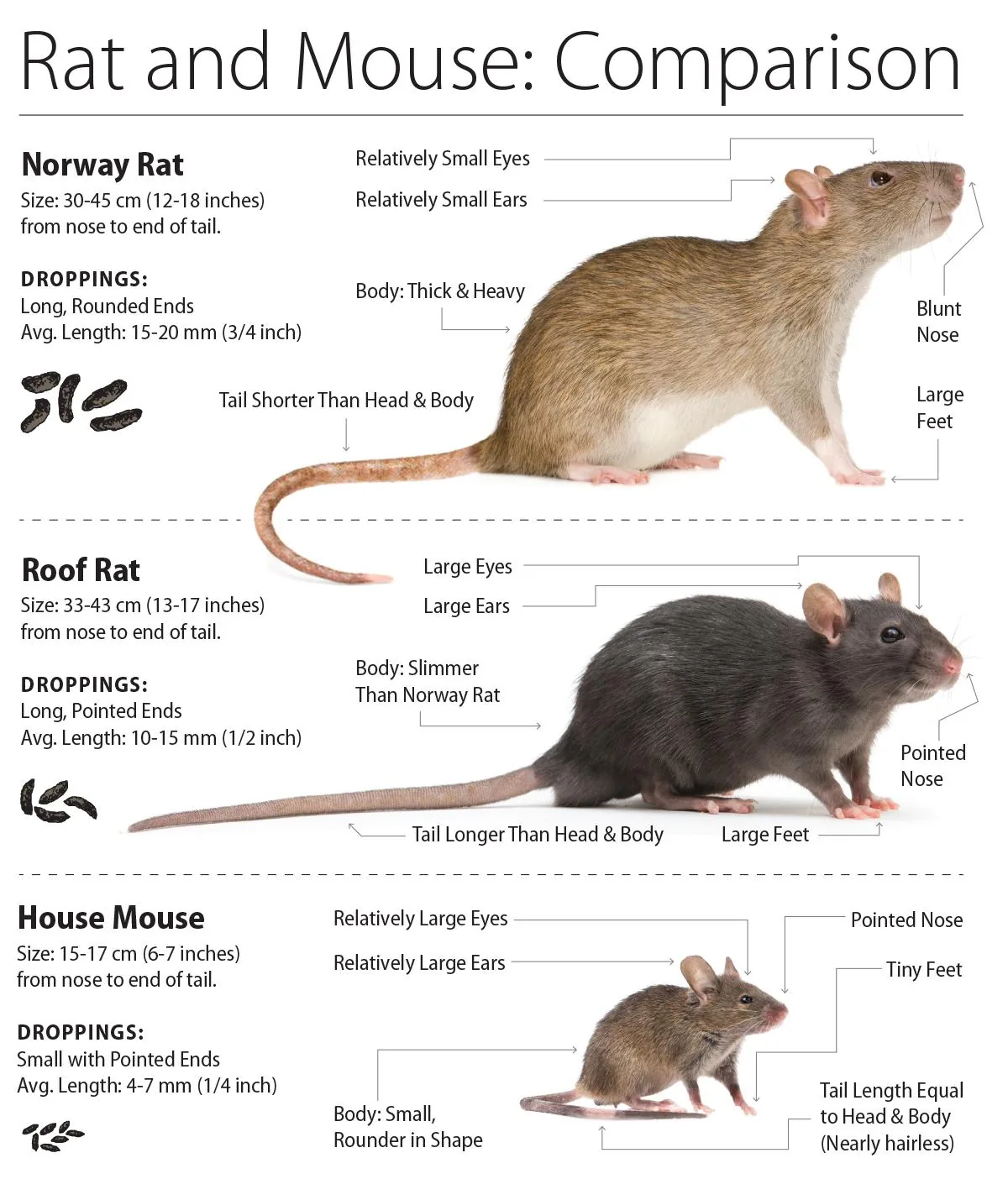
The three primary commensal rodents found in urban and residential areas are:
- Norway rat (Rattus norvegicus) also called the brown or sewer rat. Stocky and large with a blunt nose, it prefers to nest in burrows, subfloors or lower levels of buildings. Female Norway rats can produce up to 12 pups per litter and several litters per year.
- Roof rat (Rattus rattus) sometimes called the black or ship rat. Slender and an agile climber, it tends to nest in high places such as attics, roofs and trees.
- House mouse (Mus musculus) small and slender with a pointed muzzle and large ears. Highly adaptable, it can squeeze through gaps as small as 6.5 mm.
Source: Rat and mouse guide by A1 Pest Control
The Norway Rat (or Brown Rat)

Scientific Name: Rattus norvegicus
General Information
| Head-body: | 180-255mm |
| Tail: | 150-215mm |
| Weight | 280-480 grams |
| Gestation Period | 21-23 days |
| Litter size | 7-12 (up to18) |
| Number of litters | Approximately 6 litters per year |
Distribution of Brown Rats in Australia:
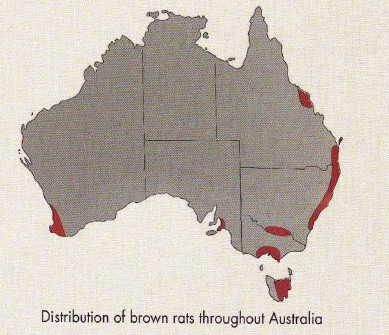
Brown rats are highly adaptable rodents, capable of thriving in various habitats. While exact figures may vary, rough estimates suggest that brown rats constitute approximately 90% of the rat population in urban areas like Sydney.
Beyond the city limits, they can also be found in rural regions, particularly near human settlements and agricultural areas.
Several factors contribute to the prevalence of brown rats in Sydney and across Australia:
- Urbanization: Rapid urbanization creates abundant food sources and shelter for brown rats in densely populated areas like Sydney. The proliferation of buildings, sewers, and other man-made structures provides ideal nesting sites and refuge from predators.
- Climate: Sydney’s temperate climate facilitates year-round rat activity, with mild winters and warm summers supporting continuous breeding cycles. This climatic advantage allows brown rats to maintain robust populations throughout the year.
- Human Activities: Human behaviours, such as improper waste disposal and inadequate sanitation practices, inadvertently support rat infestations. Discarded food scraps, overflowing garbage bins, and neglected maintenance of urban infrastructure create ideal conditions for rat proliferation.
A1 Pest Control Sydney can help identify where rodents are nesting, how they are entering the building, and which treatment method is most suitable.
For professional help, visit A1 Pest Control Sydney’s main page for Rodent Control Sydney.

A1 Pest Control, your local pest experts! 0417 251 911
Why rodents are hard to remove
Rats and mice stay close to food, shelter and warmth. They exploit gaps around pipes, vents, rooflines, garage doors, broken tiles, wall cracks and poorly sealed external doors. Once inside, they may nest in roof voids, subfloors, kitchens, storage rooms, garages, sheds, wall cavities or ceiling spaces. DIY traps may catch one or two rodents, but they rarely solve the whole problem if entry points, food sources and nesting areas are left untreated. Effective rodent control usually involves inspection, baiting or trapping, exclusion, sanitation advice and follow‑up monitoring.
Signs you may need rodent control
Common signs of an infestation include scratching in the roof at night, droppings in cupboards, chewed food packaging, greasy rub marks along walls, changes in pet behaviour, unpleasant odours, nests made from shredded material and gnawing damage around timber, plastic or wiring. If you suspect rats or mice are active in your property, arrange an inspection before the infestation grows.
Updated Rodent Regulations in NSW: What Homeowners and Businesses Need to Know
Rodent control in New South Wales has changed. New animal-welfare rules and APVMA rodenticide restrictions mean that old-style rodent treatments, especially glue boards and unrestricted use of powerful second-generation anticoagulant baits, are no longer acceptable.
For Sydney homes, strata buildings, restaurants, warehouses and commercial sites, rodent control now needs to be more targeted, more secure and better documented.
Glue traps are effectively banned in NSW
Under the Prevention of Cruelty to Animals Regulation 2025, glue traps for rodents are now effectively banned in New South Wales. A glue trap may only be set if it has a protective cover that prevents any animal from contacting the adhesive, and NSW is prescribed as an area where these traps must not be used in the normal way.
That means glue boards should not be used for routine rat or mouse control. Many retailers have removed them from sale, and pest-control professionals now recommend legal alternatives such as snap traps, lockable monitoring stations, exclusion work and targeted baiting.
Restrictions on SGAR rodenticides
The other major change involves second-generation anticoagulant rodenticides, commonly called SGARs. These include active ingredients such as brodifacoum, bromadiolone, difenacoum, difethialone and flocoumafen.
The practical message for our customers is simple: SGARs are not ordinary DIY baits anymore. They must be used carefully, by properly licensed technicians, in accordance with current APVMA-approved labels.
Key restrictions include:
Licensed use only: SGARs should only be purchased and applied by licensed pest-control technicians.
Secure bait placement: Baits must be placed in tamper-resistant, lockable bait stations. Mouse bait stations must remain indoors. Rat bait stations must be close to buildings and should not be placed directly into burrows.
Limited treatment periods: SGAR treatments must not simply continue indefinitely. Sites need monitoring, carcass checks and proper disposal procedures.
Higher-risk products removed: Products without required bittering agents and dyes, along with certain liquid or powder concentrates, have been cancelled or restricted.
First-generation anticoagulants such as warfarin and pindone may still be available, but they also need secure placement and proper label compliance.
Integrated pest management is now essential
The best rodent control program is not just “put bait everywhere.” That approach is outdated and can create risks for pets, wildlife and children.
Modern rodent control should combine inspection, sanitation, exclusion, monitoring, trapping and carefully managed baiting.
Sanitation and exclusion
Good sanitation and building maintenance are the foundation of rodent prevention. Rats and mice are attracted to food, water and shelter, so the first step is to remove what they need to survive.
Seal gaps and holes with rodent-resistant materials such as metal mesh, steel wool and suitable sealants. Repair broken roof tiles, damaged vents, loose door seals and gaps around pipes. Store food, including pet food, in sealed containers. Keep bins closed, remove clutter and clean up food waste quickly.
For commercial sites, this also means improving waste-management procedures, loading-dock hygiene, bin-room cleaning and staff food-storage practices.
Mechanical traps
Mechanical traps remain legal and useful. Snap traps can provide quick control when placed correctly along rodent runways, against walls, near harbourage areas and close to feeding points.
Live-capture traps may be used where non-lethal control is preferred, but they require frequent checking and are not always practical for large infestations.
Glue traps should not be used for routine rodent control in NSW because of the current legal restrictions.
Natural predators
Cats, owls and other predators may reduce some outdoor rodent activity, especially in rural or semi-rural locations. However, relying on predators alone is not a proper rodent-control program. Predators do not seal entry points, remove food sources or solve nesting inside roof voids, wall cavities or commercial kitchens.
Professional baiting
Rodenticides should be treated as a last-resort tool, not the first and only option. A licensed pest-control technician can decide whether SGARs, first-generation baits, non-anticoagulant products, traps or monitoring stations are suitable for the site.
A professional program should include inspection, identification of nesting and entry points, secure bait placement, follow-up checks, carcass removal where possible and written recommendations for long-term prevention.
Call A1 Pest Control Sydney
If you suspect rats or mice in your home, business, strata building or commercial premises, contact A1 Pest Control Sydney on 0417 251 911 or email bruce@a1pestcontrol.com.au
A1’s licensed technicians can inspect the property, identify rodent activity, locate entry points, recommend sealing work and implement a compliant integrated rodent-management plan.
Further reading and official sources:
- NSW legislation: Prevention of Cruelty to Animals Regulation 2025
- NSW Department of Primary Industries / animal welfare guidance on glue traps
- APVMA rodenticide / anticoagulant review page
- APVMA product label search portal
- NSW EPA or Local Land Services pages on rodenticide risks to wildlife
 The Australian regulator has moved to tighten the use of second-generation anticoagulant rodenticides, often called SGARs, because of risks to pets, wildlife and birds of prey that may eat poisoned rodents.