
WEST INDIAN DRYWOOD TERMITE
Cryptotermes brevis (Walker)
[Isoptera: Kalotermitidae]
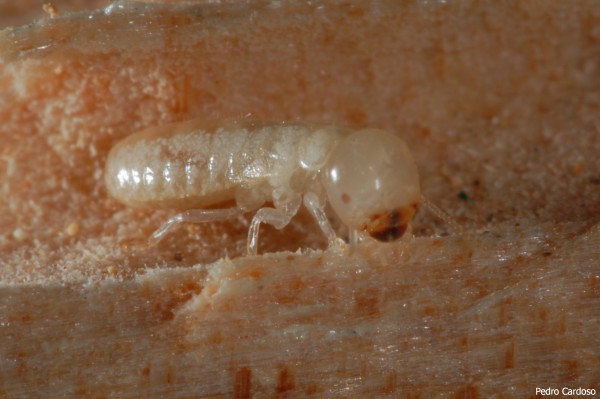
Identification: Cryptotermes brevis (West Indian Drywood Termite)
Adult (Soldier Caste)
Length: 4–6 mm
Body shape: Cigar-shaped
Colouration: White
Cuticle: Not sclerotised
Head
Shape: Sloping, rough, and phragmotic
Constriction: Narrowed behind the frontal lobes
Mandibles: Very short and broad (soldier caste)
Fontanelle: Absent
Antennae: Bead-like (moniliform), approximately equal to head length
Eyes: Small and sometimes reduced to only a few facets
Thorax
Wings:
Adult worker and soldier termites lack wings
Primary reproductives possess wings only for the nuptial flight
After pairing, the king and queen shed their wings, leaving wing scales
Reproductive wings are narrow, longer than the body, and sparsely veined
Pronotum: Flat, without anterior lobes
Legs: Uniform in size and structure
Tarsi: Four-segmented
Abdomen
Cerci: Two-segmented, located at the apex of the abdomen
Distribution and Incursion History
Among invasive drywood termites, the West Indian drywood termite (Cryptotermes brevis) is regarded as one of the most destructive species worldwide. It has been established in Australia for several decades and is regularly detected along the eastern seaboard, with Queensland experiencing the highest infestation rates.
In mid-2019, another invasive drywood termite species was confirmed in Australia following its discovery in the structural roof timbers of a residential property in Kingsgrove, Sydney. This species, Incisitermes minor—commonly known as the western drywood termite—is a major structural pest throughout the southwestern United States and northwestern Mexico.
Over time, I. minor has expanded its range across the United States as far as Florida and has been introduced internationally into countries including Canada, China, and Japan. This spread is largely attributed to the commercial movement of timber and wood products. Although I. minor had previously been intercepted in Sydney within portable timber items such as furniture, crates, and pallets, the Kingsgrove incident represented the first confirmed infestation of structural timber in Australia.
The infestation was initially detected by the homeowner, who observed small accumulations of frass pellets (termite faecal material) on her bedroom windowsill. Further investigation revealed that the pellets were being expelled from a small hole in the upper section of the window frame.
Pest Status and Economic Importance
The West Indian drywood termite is widely regarded as the world’s most serious termite pest of residential structures. Infestations frequently remain undetected until significant structural damage has occurred or timber failure is evident.
Key characteristics contributing to its pest status include:
Colonies exist as multiple small, independent nests rather than a single central colony
Infestation can occur in both sapwood and hardwood
Colonies are easily transported in small timber items, increasing the risk of spread
No contact with soil is required; termites survive on the moisture content of wood
Damage is often concealed and difficult to detect during early stages
As a result, infestations may persist unnoticed for extended periods, substantially increasing repair costs and structural risk.
For expert termite inspections and advice in Sydney, contact:
Bruce Gow
A1 Pest Control
Mobile: 0417 251 911
Email: bruce@a1pestcontrol.com.au